
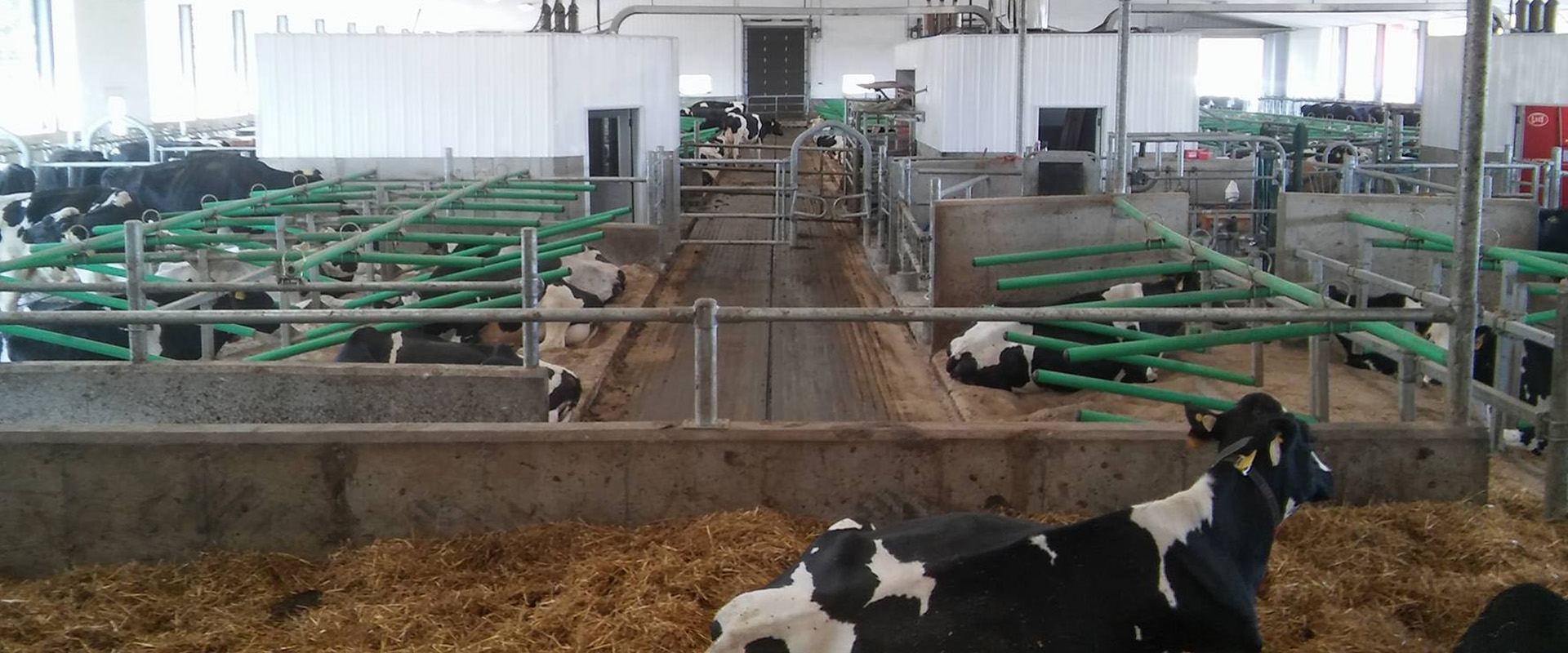
Slotted and drilled concrete grooving

Slotted and drilled concrete grooving for dairy cows
Directional traction designed for modern barn environments
In modern livestock facilities, managing concrete floor traction is a critical factor for animal safety and productivity. Over time, concrete surfaces naturally wear down, become polished, and turn dangerously slippery. This effect is intensified by constant animal traffic and manure scraping, significantly increasing the risk of slips, injuries, stress, and lameness.
Slotted and drilled concrete grooving for cows is a proven technique designed to restore effective traction while respecting the natural biomechanics of bovine movement. Unlike multi-directional texturing methods, this approach follows a simple but highly efficient principle: creating targeted grip in alignment with actual animal traffic or scraping direction.
What is slotted and drilled grooving?
Slotted and drilled grooving combines two complementary interventions on concrete surfaces:
- Drilled holes: localized anchoring points that enhance hoof grip
- Slotted grooves (linear cuts): continuous lines that provide primary directional traction
These two elements are not applied in multiple directions simultaneously. The orientation is selected based on how the surface is used:
- Either optimized for cow movement
- Or aligned with manure scraping direction
This principle is essential. In agricultural applications, grooving is typically aligned with scraping direction to optimize both traction and maintenance efficiency.
Intelligent traction designed for real animal movement
Unlike overly aggressive or uniform surface treatments, slotted and drilled grooving is designed to achieve a precise balance between grip and comfort.
The slotted grooves create a directional structure that:
- Stabilizes forward movement
- Naturally guides cow locomotion
- Reduces loss of balance
The drilled holes play a complementary role:
- Acting as localized anchoring points
- Reducing micro-slips
- Improving grip in high-stress zones
Together, they create a safe surface that remains gentle on hooves while significantly improving stability.
Why choose slotted and drilled grooving?
1. A solution adapted to Quebec dairy farm conditions
Dairy operations in Quebec face specific environmental challenges:
- Constant humidity
- Presence of slurry and manure
- High traffic intensity
- Seasonal temperature variations
Slotted and drilled grooving is designed to perform under these demanding conditions, providing long-lasting traction even in harsh barn environments.
2. A tangible improvement in animal safety
Slippery concrete is one of the leading causes of injuries in barns. The consequences are well documented:
- Frequent falls
- Increased stress levels
- Hesitant movement patterns
- Reduced productivity
Textured surfaces significantly improve footing stability and help restore cow confidence. A non-slip flooring system is widely recognized as essential for maintaining herd health and performance.
3. Effective lameness prevention
Lameness represents a major economic burden for dairy producers:
- Veterinary treatment costs
- Reduced milk yield
- Early culling of animals
Grooving directly addresses the root cause by improving hoof stability. Better traction reduces joint strain and long-term hoof stress.
4. Improved daily cow movement
Cows move multiple times a day:
- Toward feeding areas
- Toward resting stalls
- Toward milking systems or robots
Properly grooved floors encourage natural, fluid movement. In contrast, slippery surfaces discourage movement, which can negatively affect both behavior and overall herd health.
Slotted or drilled: how to choose?
One of the strengths of this method is its flexibility. Depending on the situation, different configurations can be used:
Slotted grooving (linear cuts only)
Best suited for:
- Long alleys and circulation lanes
- Mechanical scraping zones
- Areas requiring efficient manure drainage
Grooves provide continuous traction while allowing effective slurry evacuation.
Drilled grooving (anchoring points)
Recommended for:
- Stopping zones
- Waiting areas
- High-stress or high-traffic points
Drilled points provide additional grip where movement is less predictable.
Combined slotted and drilled system
In some cases, combining both methods creates the optimal balance between:
- Traction
- Comfort
- Durability
Each project is carefully evaluated to determine the most effective configuration.
Where is slotted and drilled grooving applied?
This technique is particularly effective in:
- Feeding alleys
- Exercise yards
- Building exits
- High-traffic circulation areas
These zones are critical for herd movement and benefit greatly from improved surface safety.
A durable and cost-effective solution
Concrete grooving offers a strong alternative to other flooring solutions:
- More affordable than rubber mats
- Compatible with existing concrete surfaces
- Long-lasting performance
By enhancing your existing infrastructure, you avoid major reconstruction costs while significantly improving safety and efficiency.
A tailored approach for every farm
Every barn has unique conditions:
- Bedding type
- Animal density and traffic
- Herd age and weight
- Existing concrete condition
That is why a customized assessment is essential. The choice between slotted, drilled, or combined grooving depends entirely on your operational reality.
Investing in peace of mind
Beyond the technical benefits, slotted and drilled grooving is a strategic investment:
- Fewer accidents
- Reduced stress levels
- Lower operational losses
Most importantly, it contributes to a safer and healthier environment for your herd.
Let’s discuss your grooving project
If you are noticing increased slipping in your barn, hesitant cow movement, or signs of lameness, it may be time to act.
Our team can help assess your surfaces and recommend the most appropriate slotted and drilled concrete grooving solution for your operation.
Contact us today to improve traction, enhance animal comfort, and ensure long-term performance for your dairy facility.